
Quantum World Congress | September 2026
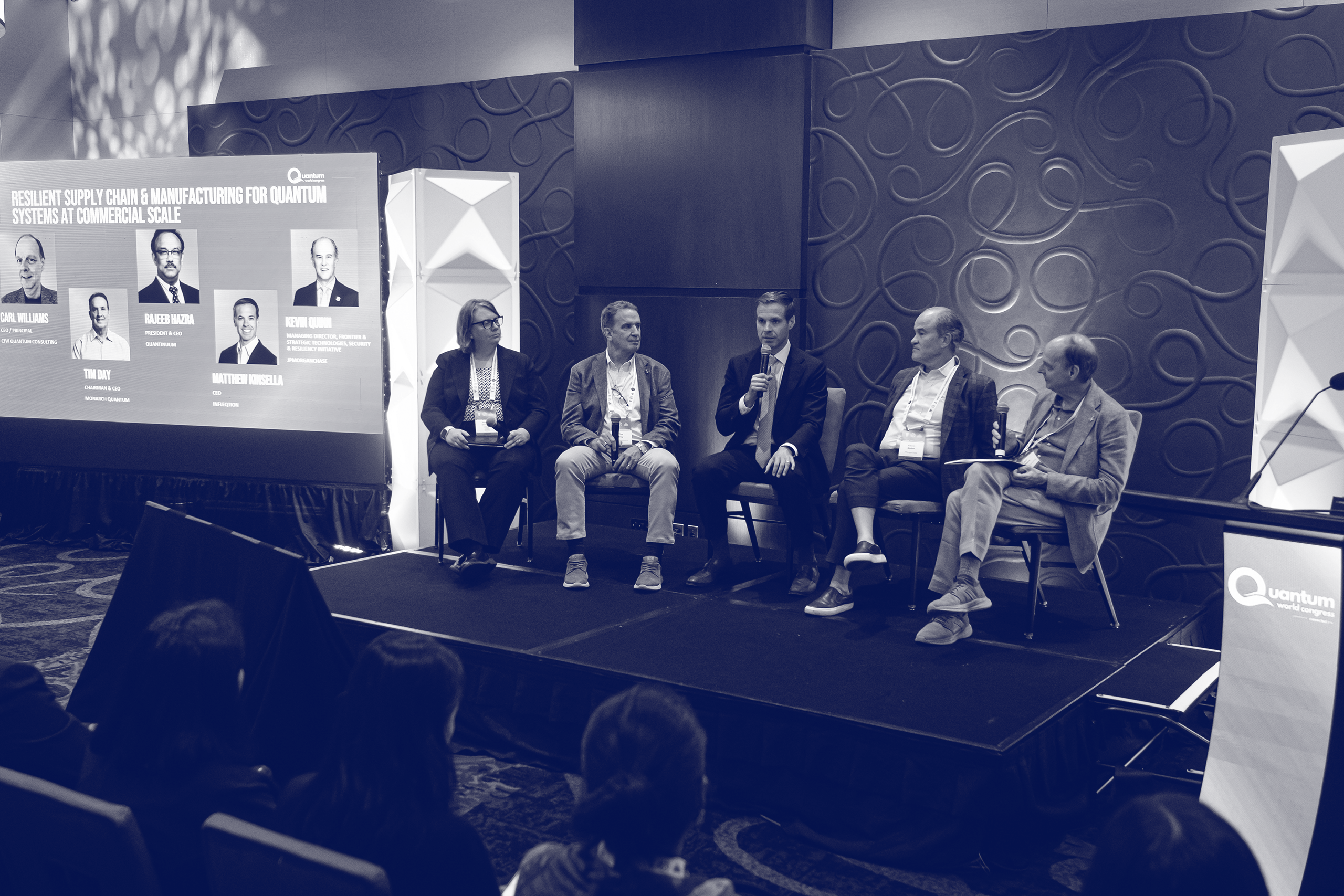
Carl Williams (00:04)
My name is Carl Williams. I’m pleased to welcome you, welcome my esteemed panelists on resilient supply chain manufacturing for quantum systems. So my panelists include a system/subsystem supplier, Tim Day.
Tim Day (00:25)
Hello everybody.
Carl Williams (00:26)
It includes two of the C-suite types from the people who would be taking things from Tim and that includes Jenni Strabley, corporate vice president from Quantinuum and Matt Kinsella from Infleqtion. And lastly it includes an investment banker, Kevin Quinn, from J.P. Morgan who is really interested in security and resiliency of the supply chain. So with that, I’m going to kind of coordinate this, and we’re going to try to [unclear] here. So let me start with giving an opening question to Tim Day.
Tim, you know, Monarch is not even one year old, but you already have a history of building companies in the photonic industry. Why did you decide to build a photonic supply chain company focused on quantum, especially given how early and nascent the quantum industry is?
Tim Day (01:32)
Thanks, Carl. You know, while Monarch is only nine months old, we’ve already grown to over 150 employees and their families really focused on the mission. And we actually started before Monarch started. We’ve been very focused on developing optical engines that can transfer, you know, and transition from development into scale. Optical engines that can serve complex systems. We started it in the telecom industry doing this for network equipment manufacturers and then a portion of that team went and decided to do this for defense industry where we needed to do it under technology controls and put them on helicopters.
And in that second enterprise, about two years ago, we recognized that quantum was getting to the point where this remarkable physics has been demonstrated and what’s really necessary is a new set of disciplines to come along and help transition to scale. And that’s systems engineering, reliability engineering, cost engineering, size, weight, power, getting a resilient supply chain, which is why we’re here. So we’ve actually been doing it for three decades. We worked on the quantum industry for two years before we started Monarch.
We think the time is now. We’re trying to get ahead of the demand curve and build up the supply chain so that when quantum adoption starts to accelerate by the end of this decade, the supply chain will not be a limitation. And that’s what Monarch’s focused on.
Carl Williams (02:59)
So now I have a question for the rest of you up on the stage and we’ll start with Jenni at the end. What single supply chain constraint worries you most about photonics and quantum hardware right now? Is it material, a component, reliability, a process, time to do delivery, geography? What is it?
Jenni Strabley (03:19)
It’s probably a combination of some of those, but I’d say the time to delivery is the one that we think the most about, both for delivering prototypes but then also for delivering systems at scale, so production units. And so I think a lot of the suppliers are early stage suppliers or have served the academic industry for a long time so they might not have been pressure tested in what it really takes to deliver systems at scale, to deliver production scale systems, to deliver high reliability systems that work autonomously.
So I think that’s one of the big focuses for us for our photonics supply chain.
Carl Williams (04:03)
Matt.
Matthew Kinsella (04:06)
I agree with everything that Jenni said. I would just maybe classify it as well as there’s two big buckets of supply chain that I think about and one is the more exotic colors of light let’s say that we need really only for quantum and those are mostly serviced by you know, very small players and it’s up to us in the quantum community to drive the volumes that make it interesting for more of those players to create more and more of that type of supply.
And that’s where Monarch is very helpful because they specialize in a lot of those types of more exotic type of lasers and colors. And then there’s just the standard components side of things that most industries are dealing with right now. Just things like RF amps or the like where there can be long lead times for very basic products because a lot of those are going into data centers at the moment.
Carl Williams (04:59)
Kevin.
Kevin Quinn (05:01)
Critical minerals and substrates. Critical minerals like indium and gallium and substrate. We don’t do enough in this country.
Carl Williams (05:13)
So again, we’ve heard of some of these things. Let me come back to you, Tim. Again, you also have your bill of materials, and so a lot of them are sole sourced. What’s your qualified second source timeline for the riskiest ones?
Tim Day (05:30)
Yeah, I think it’s a great question. I mean, first, I’d add to the first question. Also, something as simple as fiber optics and lenses and micro optics are, you know, even though they’re commodity parts, quantum is experiencing kind of an FPGA moment that we saw in the pandemic where simple electronics chips were in short supply. You know, we’re competing in the quantum ecosystem with data centers and hyperscalers. And so even, you know, the commodity components are something to focus on. With respect to sourcing strategy, I mean part of systems engineering discipline and resilient supply chain is at the design phase you want to design in second sources.
You want to go all the way to the components and come up with a design approach that uses more than one component. So we actually intentionally don’t have sole sources wherever possible. Technically and economically what you want to do by starting early using systems engineering and reliability engineering and supply chain engineering is design for multiple sources of your critical components.
Carl Williams (06:33)
So let me ask you a second question that comes back to something Kevin mentioned. Given China’s export restrictions on gallium and germanium, inputs to lasers, detectors, photonics and other things, how exposed is your supply chain to this kind of actions and what’s your mitigation strategy?
Tim Day (06:52)
To be honest, actually, with respect to those specific materials, we don’t use germanium. The quantum wavelengths don’t require it. And we’re not having a semiconductor material shortage. Our bigger challenge is the U.S. offshored even simple things like silicon dioxide lenses into Shenzhen. I mean, our team’s effort did some of that. We set up factories in Shenzhen. So we can onshore it, but we’re not having problems with germanium or semiconductor materials for our systems. We’re more concerned about things like fibers, micro optics and lenses that are all manufactured in China.
And you’re not going to get the best quality because they’re all going to NVIDIA and Coherent and Lumentum. So if you’re even buying them from China, you’re getting the lower quality stuff.
Carl Williams (07:40)
No problems with germanium and semiconductor materials. And one final question, really coming back to the end users of your stuff. What is the lead time you are now quoting customers for a full subsystem? And how is this likely to change in the next 18 months? And what’s driving the delta?
Tim Day (08:01)
Well, I mean, Monarch’s focus, again, is to try and work very early with the system companies. Do the design and the development. And so it’s difficult to answer that question because we’re in the design and development phase which can take anywhere from six to 18 months to get the first subsystems up and running and to get the prototypes up and running. But if you do it in a manner where you’re working on supply chain resilience, you’re working on second sourcing strategy and quality and reliability, then as it matures into production, which will happen by the end of this decade, you want to be in a position where you can quote six to eight weeks.
We’re focused more on the development phase where subsystems can be anywhere from six to 18 months.
Carl Williams (08:42)
So Matt, let me follow up with you on this. So what capability does Infleqtion need to own? And where can specialist partners like Monarch help Infleqtion move faster and more resilient?
Matthew Kinsella (08:56)
The way I think about this is we have to own the system architecture. And we own, because we manufacture, a lot of the ultra-high-vacuum cells where the atoms live. And so the architecture and the owning of the atoms is what we have to make sure we own. And then we can work with the supply chain folks like Tim on using light to control those atoms. And so we do some of that internally, but that’s a part of it that I think we can work with the supply chain for. And over time, you know, right now… On the quantum computing side of things, it’s sort of like building IBM mainframes in the 50s.
So it’s a very integrated process, and all the stack has to work very tightly together. Over time, I would imagine it will bifurcate and specialize more and more. So that answer might change in the next five years.
Carl Williams (09:47)
So it’s still early days. So let me come back to you, Jenni. When Quantinuum scopes requirements for photonic subsystems, are you designing for a specific supplier’s process or are you generally mainstreaming a modular open architecture spec that lets you swap vendors and has that cost you performance and or delays?
Jenni Strabley (10:13)
So for the most part we design our requirements around what we need and they’re supplier agnostic. So some of these requirements documents can be incredibly detailed and incredibly long and very sophisticated. So even putting those requirement documents together is quite a significant amount of work. But we draw those up to be agnostic to the supplier and then we work with the suppliers closely and then by the time you’re getting to a preliminary design phase or a concept design phase, that’s when it becomes very customized to the supplier and their capabilities.
I think that’s kind of the evolution of how it gets customized, but if something needs to be changed down the road, you always have those requirements that you can fall back on that are agnostic and allows you some flexibility to switch in and out as needed.
Carl Williams (11:06)
So let me come back to you, Kevin, because again, you’re investing not only in the quantum companies, but also in the supply chain. When you underwrite a quantum hardware company, how much weight does supply chain resilience, dual sourcing, hardware bill of materials transparency, geographic diversification, other things carry in you making your investment decision or is it purely technical differentiation?
Kevin Quinn (11:33)
Well, you know, I’m a bit of a supply chain geek, so I care. But if you look at investors, I would say not much. You know, when you think about how early stage the quantum industry is, say, relative to the electronics industry. Electronics industry has been around for at least 40 years. You know, most quantum companies are valued on a terminal value basis, not next year’s earnings or 2028 earnings. And when you start thinking about terminal value type valuations, things like supply chain and resiliency may matter less.
What I find fascinating though is in the public markets, look at all the companies with AI exposure. Where do 90 plus percent of leading edge logic chips get made? Where over 90 percent of them packaged? Where over 90 percent of all high density and ultra high density printed circuit boards assembled in China and Taiwan? And are AI companies trading at a resiliency discount? They should be, but they’re not. And so I would say it depends on your flavor of investor in this industry.
Let’s get it right from the start. You know let’s have a resilient supply chain from the very beginning and then we won’t have the challenges that the electronics and the AI infrastructure business has today.
Carl Williams (12:55)
So let me kind of take this a little farther and we’ll go back to all of you on this one. Given that you would like to have that flexibility let me ask you. And let’s just start down here with Jenni and we’ll just come back to all of you and let Kevin have the final on this. Given that you want to have some of that capability more in-house or at least in like-minded countries, what would you do or what would you recommend back to the government or suggest needs to be done to ensure that we don’t have that same vulnerabilities that Kevin just discussed?
Jenni Strabley (13:29)
Yeah, I think there’s a good combination of allied folks. We should have a lot of flexibility to go work with allied folks on components. I think we should have a lot of flexibility to go work with components and then look and see where does it make sense to bring things onshore? How does it make sense? The photonics industry especially has been heavily European centric and that’s changing I think and we hope to continue to have more geographic diversity in it. But I think it’s got to be a combination of this is a global effort still to get this done.
Tim Day (14:05)
Yeah, I would agree with that. I think a hybrid approach is definitely necessary, especially in the near term. I think there is a tremendous amount of capability in Europe and with allies, especially in photonics, and we need to be able to, you know, count on our allies and, you know, depend on our allies. Even for simple things like crystals and lenses and things like that that we already know the government doesn’t want and won’t tolerate this being manufactured in China. And we offshored it to Shenzhen.
I was involved in building factories in Shenzhen. They do it in telecom now. And so we need to have a hybrid approach, I think, first and foremost. And I think that that would be one piece of feedback to our government friends. And the other is, if the government was going to do something, give some clear demand signals. Help with creating some clear demand that doesn’t just trickle down from the top and hope that it gets into the supply chain but really creates a demand signal that gives the supply chain reason to invest and then we’ll invest.
We are investing in our supply chain. We are investing in our suppliers and getting clarity on demand signals would be helpful. So allied support hybrid approach and clarity on demand.
Matthew Kinsella (15:18)
I completely agree on the allied support side of things and maybe to take the clarity on demand one step further. We don’t need, in my opinion necessarily, grand prizes or challenges from the US government for quantum breakthroughs anymore. What I think would be much more helpful is to be very loud that there is an end market for these products when they become valuable and become useful. Already there for quantum sensing and when quantum computing becomes commercially useful. Not asking them to buy anything that’s not of value, but verifying that when these do become commercially valuable, there is a big end market there, which will help stimulate the supply chain to Tim’s point and have a number of other follow-on benefits as well.
In terms of policy, I don’t really know. I was with the Department of Commerce in NIST a couple of days ago, and I sort of asked back to them, I don’t know from a policy perspective what you can do. I’ve always thought it’s sort of on us to create the, you know, the conditions for the supply chain to fall into place. But I’m open to interesting policy ideas that could help with the supply chain.
Carl Williams (16:23)
And Kevin, coming back from the investment [side], what do you have to add to this?
Kevin Quinn (16:28)
Well, you know, I spent two years in the CHIPS program, so I’m kind of acquainted with industrial policy and how grants help to accelerate the reshoring of the semiconductor manufacturing I don’t know [that] it would be a great world to live in if everything was in China and everything was in the U.S. I mean, I absolutely think a hybrid and an allied approach is the only way to think about all supply chains. Because I know our friends and colleagues outside of either of those two countries, they want to have resiliency in their country as well.
And so, I think that’s something that we all ought to think about. The kinds of incentives that I think have worked most effectively in the semiconductor industry has been the investment, the advanced manufacturing investment tax credit. You know, that applies pretty narrowly. The supply chain companies, kind of below the front-end manufacturers and packaging companies, you know, they don’t get the benefit of that. I think, you know, we could do some very intentional tax credit policy around, in and around quantum and other strategic sectors or sectors of national security concern.
And that’s probably clearly true given all the adjacencies for a lot of the tech.
Carl Williams (17:50)
So let me ask you a second question. Are you seeing capital flow toward the enabling supply chain, cryogenics, photonic components, control electronics, as its own investable category? Or is it still treated as a cost line for qubit layer bets?
Kevin Quinn (18:10)
Listen, I think folks understand the importance of infrastructure. I think the recent CHIPS award, where almost 70 percent of the money, the CHIPS awards related to quantum, went to infrastructure-related projects. I think investors are kind of agnostic as to technology. They don’t quite understand what is the winning flavor of trapped ion, neutral atom, superconducting. A picks-and-shovels play, companies like Tim’s, Monarch Quantum, they kind of play across those different process techs, I think are really, are much more interesting to folks because you’re not asking them to kind of, I’m going to bet on, you know, five, you know, at the roulette wheel.
You get to at least cover half of it with like, I’m going to bet on red. And so picks and shovels is a nice way to bet on red.
Carl Williams (19:08)
Great. Great answer. I agree. I’m not much of a gambler in that regard.
Kevin Quinn (19:15)
Neither am I, but some of these people out there are.
Matthew Kinsella (19:18)
And actually, you know what, Carl? There’s another element to this too which is there has been immense success investing in the A.I. supply chain as a theme amongst many investors and what do investors love more than anything, to be able to say, I’ve seen that movie play out before, having been an investor for 18 years. I know that game very well. And I think a number of supply chain investors are looking at quantum and saying, OK, I’ve seen this movie play out before.
We can benefit from investing in supply chain companies.
Carl Williams (19:48)
So I’m now going to do a few very quick questions across the team. And if we have time, we can take one or two questions from the audience. So if I come back and say name me the one component or near-term bottleneck for your part of the stack? What is it Jenni?
Jenni Strabley (20:06)
Yes, it’s already been said, but I’ll say it again, that right now we’re in this kind of weird era of competition with data centers, and I don’t know that that’s as clear to everyone that even buying something that’s fairly commodity right now, which is optical fibers, which isn’t necessarily, it’s needed for production devices, but it’s also needed for development devices. And right now, we’re not drawing the volumes for those optical fibers that are competitive with data centers. And so I think we will be drawing those volumes at some point, but not today.
And so when it comes time to have those orders placed, we’re having trouble getting those orders filled. So that’s a really commodity part that right now we’re having trouble sourcing. And there’s other commodity parts too. But we’d really like to get our technical teams back to figuring out how to build our next generation quantum computers, our next generation subsystems, and a little less emphasis on some of these near-term bottlenecks that are happening in the supply chain.
Tim Day (21:05)
Yeah, to be honest, my rapid-fire answer is basically the same. Surprisingly, there’s lots of bespoke components inside quantum, and we’re working with hundreds of thousands of components, and amazingly, but really, fiber optics, micro optics, and lenses are in short supply. It’s the FPGA moment for quantum.
Matthew Kinsella (21:27)
I would say, you know, if I bucket it into the, you know, how do you control the atoms versus how do you control the light, we control our own destiny on the how you control the atoms for the most part. On the how you control the light side of things, we raised a lot of capital so we can build inventories, which is one of the nice things about having capital. So we do see supply chain bottlenecks, we can, you know, get our fair share of it.
But on those more exotic colors of light that I’d mentioned where it’s really only relevant for certain quantum applications, there are relatively long lead times for some of those types of lasers and photonics. So I’d give that as my answer.
Kevin Quinn (22:05)
I mean, I’ll take some literary license here because my part of this stack, I think it’s cash. And so I think what the bottleneck there is, you know, tell investors, how many quantum computers does the world need? Does the world need a hundred thousand, a million, 10 million, a hundred million, a billion. I don’t know. But if you want to see more cash come, let’s convince people that it’s a really big number.
Carl Williams (22:35)
Great answer. So a question on the policy side. So if there was one policy change that could happen, export control, funding, standards. What would most reduce your supply chain risk? And this time, let’s start with Matt and go back the other direction.
Matthew Kinsella (22:51)
So policy is definitely my weak point. So as I said, when I was with some of the policy folks this week, I asked the question back to them. But if I just, maybe this is a form of policy. What I have observed is we have operations in Australia and the UK and here in America. And there is concern about the ability to share the supply chain between all of those very close allies. And so folks wanting to develop their own supply chains.
And that’s completely understandable. But if there was a way to just make everyone feel much more confident that the supply chains could be shared, I think that could eliminate some redundancy.
Carl Williams (23:32)
So regulatory clarity among the allies.
Matthew Kinsella (23:36)
Yeah, sure. Again, don’t know the specific terms, but sure. Yeah, that sounds right.
Tim Day (23:42)
Yeah, my thought would be similar to what Matt said previously on an earlier question, but stimulating demand, but really giving visibility to the applications that will be realized with quantum advantage or utility scale or fault tolerant, so that we can really segment that market, so clarity on the demand so that we can make investment decisions with foresight on how much demand there will be. And I think if the government can help with that, since there’s going to be a very big user, that would be the one policy thing that I’d like to see more from is clarity on demand and application.
Carl Williams (24:17)
Jenni.
Jenni Strabley (24:18)
On the export control front, I think there’s a healthy set of no license required export countries, but for those that you want to work outside of that list, and again, I’m not talking about working in places we shouldn’t work, but there’s a large spectrum in between of places where we’d like to work. Export license is required to go work there. Making sure that you could have continuity of a longer term export license. That it’s not going to be a year to year export license because that puts a lot of risk at both people on both sides of the transaction.
That you could go do some great work with them and then not have the ability to actually do business with them and vice versa. You know that they might not have the ability to sell to you afterwards. So having some assurance that long-term export licenses are possible.
Carl Williams (25:03)
Kevin.
Kevin Quinn (25:06)
Coherent trade policy. If we want people to manufacture domestically let’s not make it harder and more expensive for them to do that. And that’s clearly what’s happened for example in the semiconductor capital equipment market, where we’ve made it harder for those manufacturing in the U.S. to be competitive and be successful. And so we ought to think very carefully about the industries that we’d like to develop domestically and ensure we’re not disadvantaging them by a lack of coherence with our trade policy.
Carl Williams (25:43)
So if we have a quick question from the audience. Anybody have a quick question? Go ahead.
Audience member (25:55)
In your supply chain strategy, how big of a part does supplier development play in that? Are you looking into a specific lever such as a mentor-protege program or standing up or any joint ventures that would protect government use rights, limited purpose rights, those types of things. How big of that is in your strategy?
Jenni Strabley (26:18)
Certainly for us, I’d say when we go pick a very strategic partner, we spend a lot of time with them upfront to make sure that they have mature policies around quality and how they protect their supply chain, how they do supply and demand planning, how they do production planning. And we kind of expect that from a company. We’re all moving very fast. And so if you have to go back and kind of help that along, that really might not be mature enough to be one of our major partnerships.
So that’s kind of a minimum bar for entry on us, I think.
Tim Day (26:50)
I would agree very much. I think supply chain investment is required and especially with a new industry like this where there are so many small suppliers. So not only do you need to invest with giving them you know NRE contracts upfront work but you’ve also got to assist them with your own engineering. So building a supplier quality engineering in your organization that can go work with the suppliers to set up a test to set up training etc. So it’s definitely a critical part of supply chain resilience.
Matthew Kinsella (27:20)
Agreed. I have a great relationship with the various suppliers in the supply chain, especially the critical ones at this stage of the industry.
Carl Williams (27:27)
Kevin, any last words?
Kevin Quinn (27:32)
Our suppliers are talented people out of colleges and MBA programs. I hope if you have kids, send them my way.
Carl Williams (27:44)
It’s been great having this panel up here, it’s been wonderful to go through this. Thank you again. We very much appreciate it.
Tim Day (27:52)
Thanks,
Panelists (27:52)
Carl. Thank you. Thank you.