
Quantum World Congress | September 2026
Host (00:03)
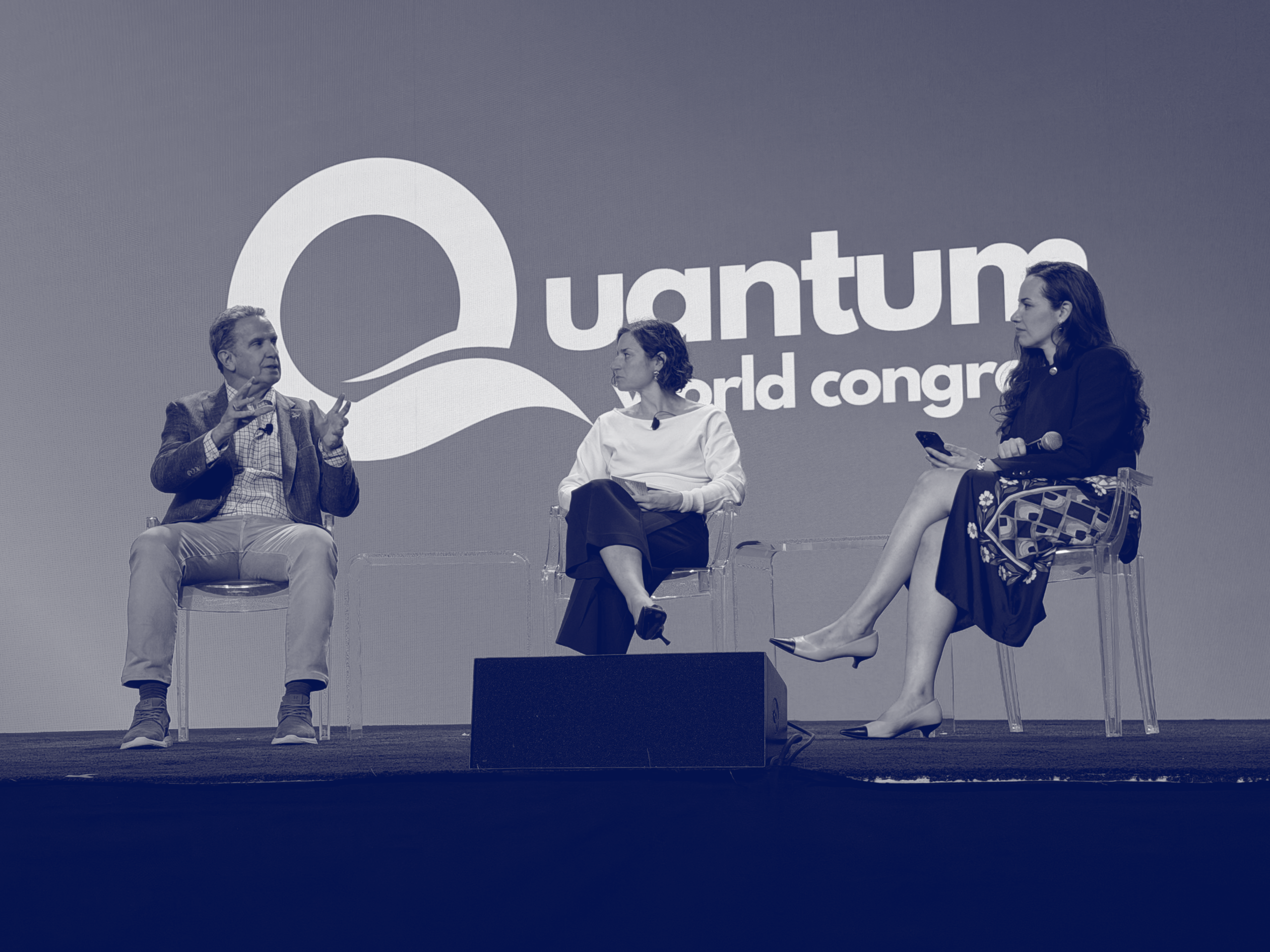
We have another one coming up, and this should be just as interesting in a different vein. So we’re going to talk about scaling quantum through strategic investment. We have a tremendous… I’m slowing, I’m slowing. All good? We have a tremendous panel here. Let me welcome to the stage, from JPMorgan Chase, Norma Padron and Sara O’Rourke, and from Monarch Quantum, Tim Day. Thank you all.
Dr. Norma Padron (00:43)
Good afternoon, everyone. Thank you so much for being here. I am Norma Padron. I’m a portfolio manager, vice president at J.P. Morgan’s Innovation Economy.
I’m sure you’ve heard it all week long, but quantum is at an inflection point. And so the question is no longer whether quantum matters. It’s how capital, policy, and manufacturing come together to make it real at industrial scale.
That’s what we’re here to unpack. We have about 15 minutes today, a few questions for each of our speakers, and a flash round at the end. Sara, we’ll start with you. You have seen industrial policy from inside the government, and at J.P. Morgan you lead the capital side. Share with us a few words on your background.
Sara O’Rourke (01:30)
Hi, everyone. I’m Sara O’Rourke. I’m a managing director at J.P. Morgan in the Security and Resiliency Initiative. It’s a $1.5 trillion effort launched by Jamie Dimon last year to facilitate, finance, and invest in critical industries, which is basically a big bet on economic and national security, and really leaning in from J.P. Morgan’s side to try and boost and support companies that are making the country stronger.
Dr. Norma Padron (01:56)
Thank you. And Tim, you’re the CEO of Monarch Quantum. You’re building integrated photonic engines and scalable hardware that quantum systems depend on. Tell us a little bit about you.
Tim Day (02:08)
All right. Thanks for having us here. My background has been deep tech for a long time. I graduated Stanford up in Silicon Valley, and we started a company right out of the university trying to transition photonics technology into telecommunications hardware.
So transitioning the technology for scale, and that’s been a theme of my entire career. After we did that, it was really combining capital, investment capital, venture capital, took it public in a secondary. We did it again with a second company where we tried to do the same thing for the aerospace and defense industry: photonics engines coming out of the lab and going into scale.
And that was really exciting. We put these engines on helicopters and into semiconductor capital equipment. And now we’re going to try and do that for quantum. And so Monarch Quantum came out of the defense and aero industry about two years ago. We started the quantum initiative, and about eight months ago we started Monarch to do the same thing for this industry.
Dr. Norma Padron (03:08)
Love that. Sara, let’s start with you and the strategic frame. J.P. Morgan has included quantum in its frontier and strategic technologies focus within the Security and Resiliency Initiative. What makes quantum a strategic technology, and how does that lens shape the way you evaluate investments in the sector?
Sara O’Rourke (03:30)
So I think of quantum like I think of AI. It is a foundational technology. Probably robotics or physical AI I’d put in that bucket as well, which we think will fundamentally set the foundation for the economy in the future.
That’s one. Two, it is the person, the country, or entity who wins the race will be not just the company or country that innovates in terms of the front-end technology, but also that has the full ecosystem. And I think we’ve seen that to date across a number of our foundational and leading technologies.
And then finally, once we do see breakthroughs in quantum, when we’re moving from research to utility scale, it’s irreversible. And we in the U.S. want to be in the lead, because who knows what new capabilities will be unlocked once there is a next wave of quantum.
And that’s why it is truly a foundational technology that we think will kind of reset how the economy functions.
Dr. Norma Padron (04:32)
I love that. Tim, Monarch Quantum is building the photonic hardware that helps quantum systems. We’ve heard a lot this week around [unclear] quantum system integrators. But you’re at the core of it, behind all of that. What manufacturing and supply chain challenges must the industry address now to be ready for the future that we’re all expecting?
Tim Day (04:55)
I think my short answer on that is we need to invest in the supply chain earlier, ahead of demand. If there’s anything I’ve learned over my career transitioning technologies into scale, it’s hardware is hard, and you can’t stand up production overnight.
And so I think the industry needs to realize that we don’t need to be just investing at the system level, for the computers or the sensors, the networks. That’s important. And we definitely want to be driving demand signals into the ecosystem at the system level, at the application level.
But if we’re not at the same time also investing in the supply chain, there’s a tremendous amount of very exotic, bespoke, critical technologies, from dilution refrigeration, from semiconductor materials, from things as simple as lenses and fibers and optics, that the quantum industry has not matured.
And so when quantum happens, and I think it will for sure happen by the end of this decade, we need the supply chain to be ready. And fundamentally, right now it’s not.
We see a lot of really exciting demonstrations and breakthrough physics at the quantum system level, and the dirty little secret, if you will, is it’s all built with laboratory experiments. It’s basically first of its kind.
Every industry experiences this. To transition this technology to scale, you see investments in the supply chain, but usually it comes too late. So I would say that the most important message is we want to see the industry invest in the supply chain ahead of demand. And we think demand is coming at the end of this decade, so that means we should be doing supply chain investments now.
Dr. Norma Padron (06:41)
Right. That’s definitely important. So now a question for the two of you. Let’s put both lenses together. Sara, from your experience leading efforts at CHIPS and your work in the Resiliency Initiative at J.P. Morgan, what lessons do you think transfer into quantum technology as it stands today?
Sara O’Rourke (07:01)
Right, yeah. So before J.P. Morgan, I was the COO and then the acting head of the CHIPS Investment Office, $40 billion to onshore semiconductor manufacturing.
I just want to echo what Tim said. I think the biggest lesson coming out of CHIPS was you need to invest in the end-to-end supply chain as you are investing in front-end capacity. So what do we now have with CHIPS? With the $40 billion, there was $800 billion announced in terms of private-sector investment. We now have memory capacity building out in the U.S. We have logic semis. We have power semis.
But what isn’t here yet is all the chemical suppliers, gas suppliers, substrate manufacturers, equipment players that you would need to have a robust ecosystem in the allied ecosystem. And so we don’t have a resilient supply chain yet. And if everything is left to its own devices, it will come, but it will probably come too slowly, because the scale doesn’t exist here and the business case doesn’t exist here.
And you see that across other foundational technologies. You see that across AI. AI has exploded. Immediately we have choke points in memory. We have choke points in semiconductors. We have choke points in power. Same thing with robotics as it’s scaling, and drones. We have actuators. We have semiconductors. We have rare-earth magnets. There’s multiple choke points as demand unlocks.
So I think the things I would say is, one, you have to invest in the demand signal to accelerate the build of utility-scale quantum. And you have to do that now. And maybe that’s the government. Maybe that’s an advanced market commitment.
Two, you have to invest now in technologies that are picks and shovels, that could go into multiple modalities and are scalable. And I think Monarch Quantum is a really good example of that, where there are some, to Tim’s point, there are certain parts of the current research-scale supply chain for certain modalities that really are not scalable from a physical perspective.
And then you need to have the evolving ecosystem around that. You need to make sure you’re working on permitting, working on workforce and other enabling factors so that it’s easy to build out in the U.S. and it’s less costly to build out in the U.S. And that’s kind of how you win that full supply chain.
Dr. Norma Padron (09:06)
And Tim, our teams at J.P. Morgan have had the chance to get to know you over the past year. And I think one of the things that I appreciate so much is your insights into when and how quantum technologies actually get to be an engineering problem.
Where does Monarch Quantum differentiate itself in that work towards getting to quantum at industrial scale? Tell us a little bit of the key differentiators that Monarch is effectively doing.
Tim Day (09:34)
Well, to echo a little bit of what Sara said as well, in order to make those transitions in the critical end-to-end supply chain, again, hardware is very hard. These subsystems and components require sophisticated manufacturing processes. There’s a lot of attention on the exciting IP and the physics associated with quantum. I’m trained in physics. I love the physics of quantum. But there’s a heck of a lot of innovation in the manufacturing side.
When you talk to Intel, when you talk to ASML, you see that there’s just tremendous innovation in the manufacturing. And it takes a passion for the engineering to redesign it from the bond joint up to be able to manufacture it repeatedly, reliably, in volume. And this type of engineering work is really what differentiates Monarch.
We come at it from a systems engineering point of view, where we look at these complex systems. They’ve been built with laboratory instruments. They work, and they do this beautiful physics. But now we’ve got to reengineer all the way down to the chip, all the way down to the lens, all the way down to the fiber, and optimize how they work together in a repeatable, reliable, scalable way. And that can be just as exciting.
And it’s the mundane engineering, but there’s plenty of innovation and passion, and I think value. It generates a lot of value for our customers, and I think that’s what differentiates Monarch.
Dr. Norma Padron (11:02)
I really appreciate that. Both of you, before we go into our rapid final questions, I’m curious: what do you think investors or the investment community are not getting just yet when it comes to the picks and shovels? And it might be because quantum is an emerging technology, or it might be that in every wave of emerging foundational technologies it happens. And so, Sara, I’m curious of your thoughts. What is the investment community not getting just yet? And Tim, as well, as a founder.
Sara O’Rourke (11:33)
I think there’s still a question. I think, first of all, and I’m not as deep in the quantum space as a number of people here, but just seeing how quickly the space has evolved in the last year alone, I think a lot of people just don’t understand: where are we in quantum? When are we going to be at commercial scale, and what does that look like? What is the total addressable market of quantum, and how will it be adopted?
And I think a lot of people will look at the AI story and kind of say, what is the actual use case? Is it consumer? Is it enterprise? How many quantum computers are we going to need? How many modalities will there be? So the end picture of what does this technology look like.
And I think a number of people will say, well, we don’t yet know. No one predicted Uber when you had the initial launch of the internet or whatever. But just getting more crisp on what does the end state look like, and what are the actual commercial use cases that I can think about and feel and touch.
And I also think they want to see more of the demand signal. And it’s hard to invest in the supply chain when you don’t have that idea of what the final total addressable market is, and then who will be demanding that supplier. And I think that’s kind of the two things that folks look at when they’re evaluating the technology. But Tim, what are your perspectives?
Tim Day (12:49)
Well, I think my two comments would reinforce what Sara is saying. But I think what investors don’t fully realize yet, but if you look at adjacent industries I think the point will be made, is how valuable excellent supply chain management can be.
And it’s not just logistics. It’s not just managing inventory. It’s not being able to… There’s 150,000 components, optical components, in an ion computer. An ion-based computer will have hundreds of thousands of components, and how they work together is a fascinating engineering problem. It’s also incredibly valuable, because if any one of those components goes down, the whole system goes down.
So this is a supercomputer that has $50 to $100 million of value, and it can be screwed up by one single component. So there’s tremendous value in the food chain. If you look at ASML, for example, they’re a highly valued company, and they’re supplying into the semiconductor industry because they make a very differentiated thing.
The second thing I think I would add is what I’ve already said. So not only do investors need to understand it’s valuable, but it’s also hard. It’s not just about collecting screws and lenses and fibers.
Actually standing up repeatable, reliable, high-quality lenses and chips is hard.
Dr. Norma Padron (14:08)
And I want to double-click a little bit of it, because one of the things that is very interesting about Monarch is that you’re bringing in some automation into it and some AI into it. And so you’re doing it in a differentiated way. Can you speak, like, one second about it?
Tim Day (14:21)
Yeah. It’s a perfect example. In the telecom industry, if you look over the last 30 years, it also uses optics, it uses photonics, it uses fibers to turn light on and off 400 billion times a second. It’s a small little package. It’s called co-packaged optics. It’s got a chip, it’s got a lens, it’s got a fiber, it’s got a little bit of electronics. What’s so hard about that?
There’s been decades and huge amounts of investment to get that to the point where you can use automated pick-and-place to assemble this reliably. That’s what we’re trying to do for quantum. We’re doing co-packaged optics for quantum. And we think that that will make the infrastructure ready when the demand comes.
Quantum is happening. It’s not a matter of if, it’s a matter of when. We think it’s at the end of the decade, and so we need to build automated supply chain now.
Dr. Norma Padron (15:07)
I love that. So we are really at our last minute. One of the things that I really love about my job is that I never thought that as a banker I would say the word “laser” so often. So that makes it really, really cool.
Tim Day (15:19)
Lasers are awesome.
Dr. Norma Padron (15:20)
Lasers are awesome. So just before we leave, just rapid-fire, one sentence to each of you: quantum at industrial scale, what does that mean? So quantum at industrial scale, what does that mean from your perspective, from the Security and Resiliency Initiative, and from yours as well?
Sara O’Rourke (15:36)
Oh boy. I think there’s at-scale adoption, and there’s a critical supply chain that is resilient.
Dr. Norma Padron (15:44)
Love it.
Tim Day (15:46)
Quick answer: when you’re making multiple versions of the same thing because the customers want to buy it again and again and again, that’s at scale. Of course, the application has to work, but from a supply chain engineering point of view, we want to see repeatable, reliable replication of the same complex supercomputer. When that happens, you know we’re at scale.
Dr. Norma Padron (16:08)
Well, thank you so much. And thank you to the audience. As you heard it here: repeatable, resilient supply chains. Thank you so much.